June 30, 2025
Reporter, Health Care Inc. Writer
Hello, everyone! Do you have an outstanding medical bill? Maybe your provider will accept Labubus. You can always send your frustrating billing stories here, too. bob.herman@statnews.com.

insurance

Preventive care stays free, for now
RFK Jr. - AP

John McDonnell/AP

The Affordable Care Act survived yet another trip to the Supreme Court. The justices quibbled over just how powerful the members of the U.S. Preventive Services Task Force are, but the conclusion is this: Any preventive service that gets an A or B grade from the USPSTF must continue to be covered by health insurance companies at no cost for people. 

Bottom line: If you are insured, you still won’t owe a dime for several types of cancer screenings, like Cologuard, and medicines, like pre-exposure prophylaxis for HIV. But there’s a wrinkle: The USPSTF and its recommendations are constitutional only because they need to be signed off by the Health and Human Services Secretary, which is currently Robert F. Kennedy Jr. 

This potentially introduces political manipulation into what are supposed to be science-based determinations.

This isn’t just hypothetical. Federal law also requires insurers to cover vaccines at no cost for people if the vaccines are recommended by the Advisory Committee on Immunization Practices. And as I reported last week, Kennedy’s complete overhaul of ACIP with his own handpicked advisers clouds the future of vaccine coverage. 

This is America, so of course there are business implications to these developments. The stock price of Exact Sciences, which makes Cologuard, jumped by 4% Friday. The stock price of Gilead Sciences, which manufactures PrEP medications, went up 3%. Guaranteed insurance payment is a certainty unlike any other in health care. But with Kennedy holding the ultimate power over what preventive services must be covered, that certainty is very tenuous.


unitedhealth

UHC’s Medicare Advantage pullback

Earlier this month, UnitedHealth Group said it would stop paying commissions to brokers and agents, starting July 1, for new members enrolled in some of its UnitedHealthcare Medicare Advantage plans. The insurance company downplayed the move in a statement to STAT, saying it only affected a “small percentage” of its MA plans.

I obtained the full list of UnitedHealthcare’s MA plans that will no longer pay broker commissions, and cross-referenced it with federal data that shows enrollment for each MA plan contract. Those plans enrolled less than 10% of UnitedHealthcare’s 10.2 million MA enrollees, as of June. Most also appear to be enrolled in PPO plans, which have broader networks of doctors and hospitals. 

Importantly, UnitedHealthcare will not pay commissions on any of its “institutional special needs plans,” or I-SNPs. These are MA plans for very sick people who live in nursing homes — on average, MA plans get more than $35,000 per year for an I-SNP enrollee vs. $13,000 per year for a conventional MA enrollee. UnitedHealthcare controls roughly half of this market (60,000 of the roughly 122,000 I-SNP enrollees). 

Insurance companies halt commissions if they want to discourage enrollment, usually because medical costs are running higher than they expected. This has happened a lot lately in the MA market. UnitedHealth CEO Stephen Hemsley has made it clear the company will reverse “performance setbacks,” and now it’s surgically targeting MA plans that it believes have too many sick people. “They only want people in plans that are profitable,” a broker told me last week. 

More details may emerge July 29, when UnitedHealth is scheduled to report earnings, but do not be surprised if the company purposefully scales back more of its MA presence.


from the archives

Well that sounds familiar
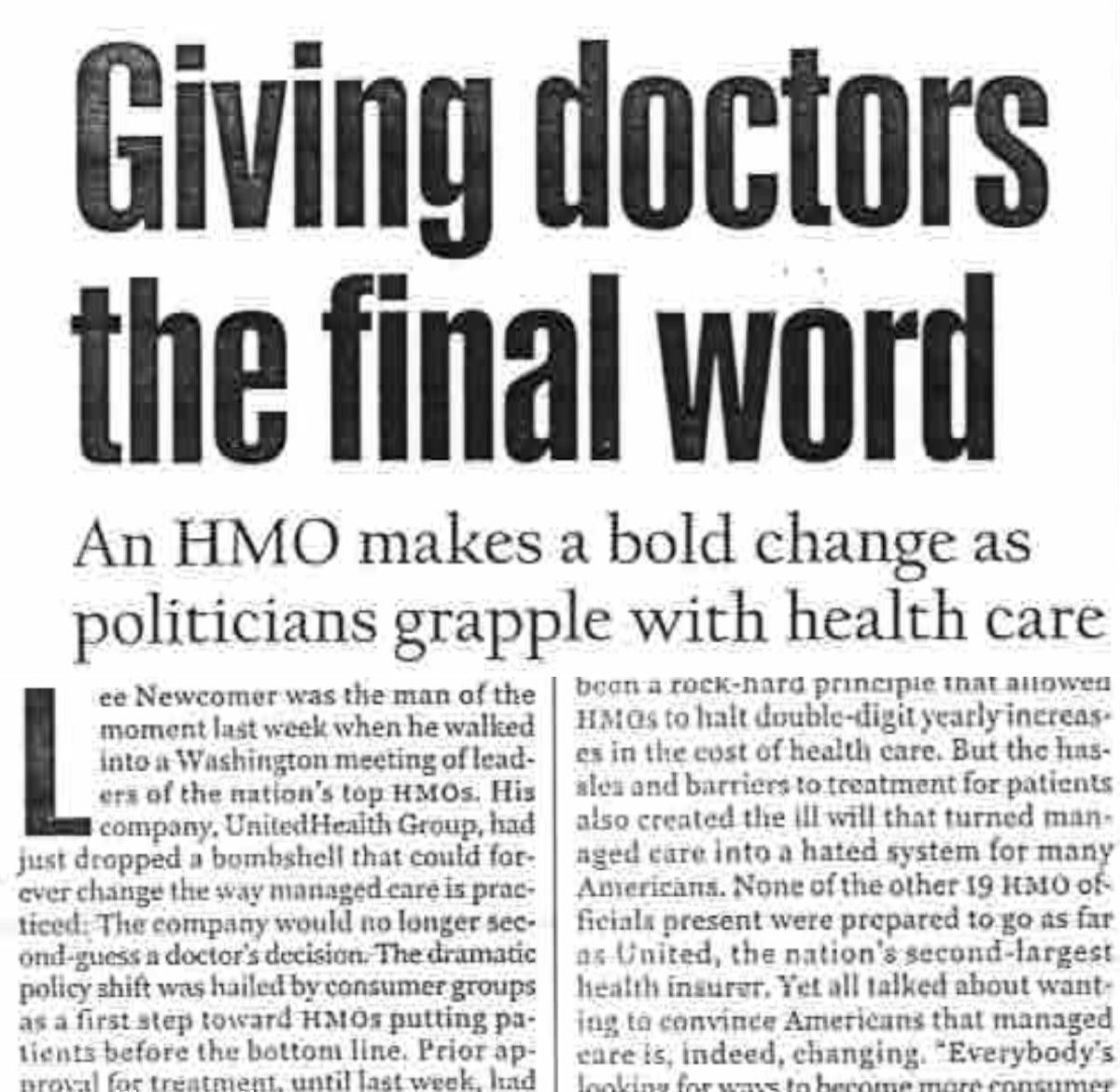
US News World Report - United HMOs prior auth 1999-1

U.S. News & World Report

The Trump administration made a big show of last week’s announcement that health insurers were making a voluntary pledge to scale back their use of prior authorizations. We’ve heard these pledges before.

Yes, these same groups made almost identical promises back in 2018. A friendly Health Care Inc. reader also passed along the above article from U.S. News & World Report, published in November 1999. The Wall Street Journal had a write-up, too. Same exact stuff, 26 years apart.


spending

$5.3 trillion

That’s how much America spent on health care in 2024, according to the newest estimates from federal actuaries. That spending total was 8% higher than in 2023. The $5.3 trillion health care tab now represents 18% of the entire economy, up from 17.6% in 2023. 

These government reports are vital. They give a snapshot of what the health care economy looks like and why certain parts are getting more expensive than others. Although the long-term predictions are, understandably, wrong all the time, it’s most useful to understand what happened most recently. And it’s clear that spending on hospitals (9.2%), medical groups (8.1%), and pharmaceutical manufacturers (10.1%) increased at rates well above inflation.


More around STAT
Check out more exclusive coverage with a STAT+ subscription
Read premium in-depth biotech, pharma, policy, and life science coverage and analysis with all of our STAT+ articles.

Industry odds and ends

  • Late Friday, the Trump administration announced a new project that will trial more prior authorization, specifically in traditional Medicare (right after encouraging commercial insurers to do less of this). From 2026 through 2031, CMS will hire companies to use “enhanced technology like AI” to root out what it calls “wasteful” care — things like skin substitutes and electrical nerve stimulators. The vendors selected for this project will be paid “based on a share of averted expenditures,” according to the government’s notice.
  • CMS released an updated list of 355 Medicare Advantage plans that will be going through risk adjustment data validation (RADV) audits for their 2019 calendar year. UnitedHealth represents 52 of those 355 selections, but those plans covered a vast majority of its membership in 2019.
  • After years of court battles and public discontent, New York City Mayor Eric Adams pulled the plug on the city’s plan to move retirees into Medicare Advantage.
  • Abridge, a company that sells artificial intelligence software to hospitals, is now worth $5 billion, my colleague Mario Aguilar reports. Investor money is pouring into Abridge and other AI scribes, which convert audio from clinical visits into electronic medical record notes — and that can also be used for billing purposes.
  • Ascension CEO Joseph Impicciche is retiring and passing the torch to Eduardo Conrado. Impicciche made $9 million in 2023, and Conrado made $4 million, according to Ascension’s most recent tax filing.
  • UPS got approval from the Federal Trade Commission for its $1.6 billion takeover of Andlauer Healthcare Group, a medical distributor that is owned by Michael Andlauer, who also owns the Ottawa Senators hockey team.
  • Cigna sued Bristol Myers Squibb and Celgene (which Bristol acquired in 2019), alleging the pharmaceutical companies defrauded the patent system over multiple myeloma drug Pomalyst and illegally bribed generic drug makers to keep lower-cost alternatives off the market until 2026. A federal judge dismissed a nearly identical lawsuit, filed by Blue Cross Blue Shield of Louisiana in 2023, this past March.

The Illustration Ward

STAT_BitcoinPivot_Final_v1_3000-2048x1152-1

Mike Reddy for STAT

It’s not a meme this week, but it’s art. Mike Reddy is one of a kind. 

This illustration goes with our deep examination of Semler Scientific, published last week by my colleagues Casey Ross, Lizzy Lawrence, Tara Bannow, and me. Semler is a small company that had a goal to detect artery disease but is now pivoting to … bitcoin. Semler quickly abandoned its foundational premise after Medicare made its screening tool a lot less profitable for health insurers, like UnitedHealth, to use.

Also make sure to watch my colleague Alex Hogan’s video interview with Casey and Lizzy about the story. There’s a hilarious AI surprise.


Thanks for reading! More next week. 


Enjoying Health Care Inc.? Tell us about your experience
Continue reading the latest health & science news with the STAT app
Download on the App Store or get it on Google Play
STAT
STAT, 1 Exchange Place, Boston, MA
©2025, All Rights Reserved.