September 28, 2026
Reporter, Health Care Inc. Writer

Hello, gang. This past December, I was begging for another season of the game show “99 to Beat.” Well, great news: It’s BACK. If you’ve never seen it, give it a try. You’ll be rooting for strangers in wacky games. Ken Jeong and Erin Andrews have infectious energy as hosts. What’s not to like? As always, send your wackiness here: bob.herman@statnews.com.

insurance

Employer-sponsored nightmare fuel

Our “Out of Pocket, Out of Reach” series has been detailing the bleak state of health insurance that workers get through their employers. Experts have told me 2027 will be even worse than this year, and recent developments at sizable public-sector employers are reinforcing just how catastrophic things are becoming.

In New Jersey, just weeks before open enrollment begins, the state is threatening to cease offering the health plan for teachers and school workers if a commission can’t agree on how to address premiums, which the consulting firm Aon said need to go up by 34% next year.

The major public school district health plan in Idaho has no money, meaning teachers’ medical claims could go unpaid, and the state is contemplating taking it over. A Texas school district faced an uproar from teachers after proposing to quadruple premium contributions, and then proceeded to backtrack. A Florida school district is grappling with deductibles that will at least double for teachers and workers next year. New York City’s transit system is asking workers to double their contributions to the health plan, as costs are expected to soar by 50% between 2025 and 2030.

Meanwhile, employees at Duke University will be paying 10% to 50% more for their health care premiums next year, depending on their salaries. Not even churches are safe. A diocese administrator in Florida told David Paulsen of the Episcopal News Service that getting hit with a double-digit premium hike “feels like an existential crisis.”


hospitals

An unusual nonprofit conversion

A chain of rural hospitals owned by Quorum Health is becoming a nonprofit. The facilities will stay open, to the communities’ delight, but as my colleague Tara Bannow reports, it’s fair to wonder if investors are getting bailed out by those same communities.

Quorum has a long, complicated history. It used to be part of Community Health Systems, which then spun Quorum off into its own publicly traded company. Quorum then filed for bankruptcy, re-emerging with the backing of private equity.

Switching to nonprofit comes with perks, such as no longer paying taxes and getting access to federal drug discounts. But Quorum’s private equity owners also happen to own some of Quorum’s debt, and they’re getting back the vast majority of what they’re owed under the conversion, while saddling the new nonprofit with a ballooning debt load.

“Are the creditors taking enough of a discount to leave a hospital company that is viable?” Jim Baker, executive director of the Private Equity Stakeholder Project, told Tara. Read more.


medicare

Labyrinthian

Medicare is proposing sizable cuts for a majority of diagnostic lab tests next year. The Trump administration is lumping the decision within its narrative of rooting out waste, but the Centers for Medicare and Medicaid Services is following federal law that requires cuts based on data collection.

Congress has routinely intervened to stave off the full effects of cuts. Some Wall Street analysts predict lab companies like Quest Diagnostics and LabCorp could lose out on millions of dollars of profit if this rule is finalized. But Molly Turco, a former top Medicare official who is a managing director at TD Cowen, wrote to investors last week that “it is most likely that Congress will punt the 2027 [lab] cuts like it has done in previous years.”


hospitals

Repeat after me: List prices matter
Screenshot 2026-09-23 at 9.56.28 PM

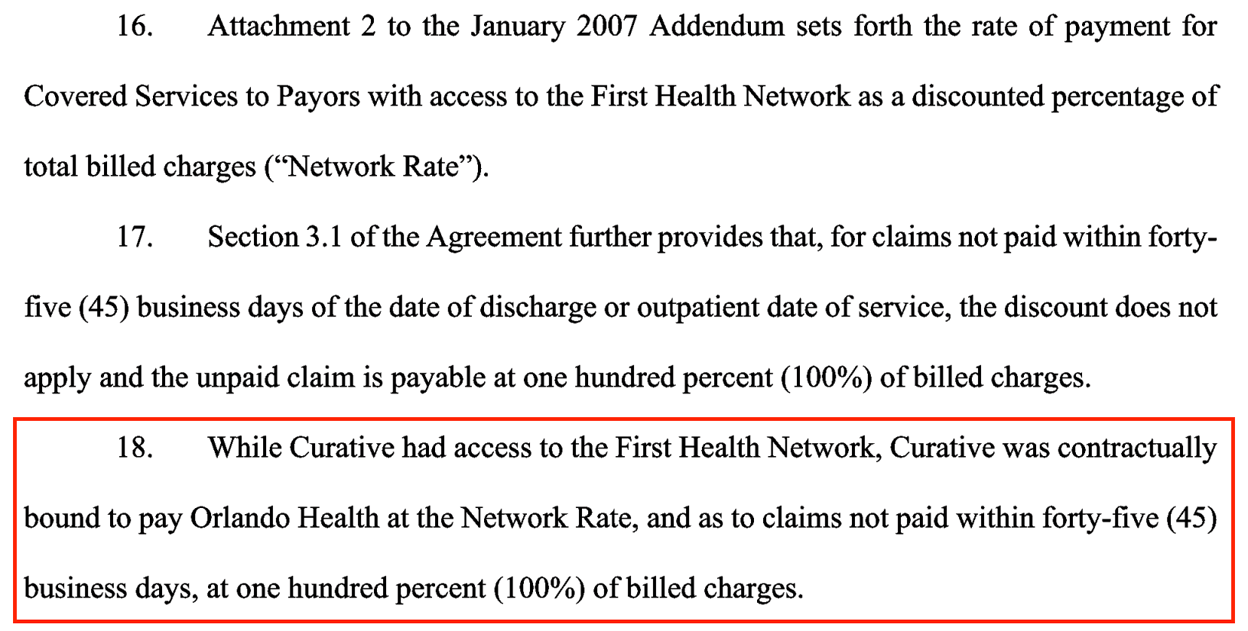
Orlando Health is suing Curative, a new-era health insurer that sells employer-based plans with no deductibles or copays for in-network care. Orlando Health, a dominant hospital system in the area, is alleging Curative hasn’t paid some medical claims and has underpaid others.

Curative had rented a provider network from CVS Health’s Aetna’s subsidiary, but then, without explanation, CVS terminated Curative from accessing that network by the start of this year. The interesting part is what Orlando Health discloses while Curative still had that rental network.

The network agreement says the insurer will pay providers at a discounted rate. But if the insurer doesn’t pay within 45 business days, they have to pay 100% of billed charges, also known as the hospital’s list prices, or chargemaster rates, according to the lawsuit.

Hospitals have claimed that billed charges are “virtually never what hospitals ultimately receive as payment” and therefore are unimportant. But as Orlando Health admits in its own lawsuit, it is contractually guaranteed to receive 100% of its list prices if the insurer does not pay in time. And it claims that amounts to more than $9 million from Curative alone. List prices matter.


artificial intelligence

More on the AI coding wars

The Blue Cross Blue Shield Association has released another analysis of medical claims that the lobbying group says proves artificial intelligence is driving up the cost of care, my colleague Brittany Trang reports.

STAT’s health tech team — including Brittany, Katie Palmer, and Casey Ross — has reported on the ways that hospitals and insurers are using AI to juice their finances. Simplified: This occurs by either coding cases that are more complex and therefore more expensive, or by denying claims. 

In this new analysis, BCBSA said hospitals are adding secondary diagnoses to complex inpatient procedures. The methodology is unclear, and there’s likely some amount of under-coding of certain conditions. But there continues to be a relationship between the rise of AI tools and hospitals getting paid more for the same services. Read more from Brittany’s archive.



More around STAT

Industry odds and ends

  • John Oliver went deep on UnitedHealth Group on last week’s episode of “Last Week Tonight.” You may notice some familiar STAT bylines throughout.
  • Democrats and Republicans in Congress are actually considering a major overhaul of how Medicare pays doctors, my colleague John Wilkerson reports.
  • This summer, Medicare proposed banning vendors from providing remote patient monitoring services on behalf of doctors. Several large health insurers — including those owned by UnitedHealth, CVS Health, and Kaiser Permanente — are opposing that change, my colleague Mario Aguilar reports.
  • Workers who take GLP-1s are chastising their employers for dropping coverage of the drugs for weight loss, Taylor Nicole Rogers of Bloomberg reports. One particularly interesting nugget: The Obesity Action Coalition, which receives funding from Eli Lilly and Novo Nordisk, is helping organize PepsiCo employees to pressure the company to resume coverage of GLP-1s for weight loss.
  • In Health Affairs: Researchers at Brown University attempted to quantify the “brinkmanship” between hospitals and health insurers — the payment disputes in which a hospital actually decides to go out-of-network. And there has been a lot more brinkmanship, with more than five times as many disputes from 2023 to 2025 than there were in 2021 to 2023.
  • Here’s a new lawsuit claiming harm from vertical integration: InfuCare Rx, a chain of pharmacies that ships specialty infusion medications, has sued Cigna’s Express Scripts for allegedly paying below contracted rates and directing patients to its own specialty pharmacies that compete with InfuCare Rx.
  • Speaking of Cigna, its investor day is Wednesday.
  • County commissioners in North Carolina voted in favor of Atrium Health taking over WakeMed. State Treasurer Brad Briner, a Republican, said he remains “profoundly concerned” about it and said it’s “not too late to back away.”

The Meme Ward

Health Care Inc. Meme - Issue 208-1


Thanks for reading! More next week. 

 
STAT
STAT, 1 Exchange Place, Boston, MA
©2026, All Rights Reserved.