December 9, 2024
Reporter, Health Care Inc. Writer
Lots to get to this week. Thanks for reading along. Send me your tips and Spotify Wrapped for this year: bob.herman@statnews.com.

insurance

A sobering week
Insurance-Card-6-Hyacinth

Hyacinth Empinado/STAT

UnitedHealth Group, the largest health care company in America, was ready for its annual investor conference in New York City last Wednesday. But executives abruptly canceled it after the company found out UnitedHealthcare CEO Brian Thompson was shot and killed that same morning. 

My colleague Tara Bannow and I were watching the live stream of the conference when the news of Thompson’s death started to trickle in. The killer still has not been caught, as of this past weekend, and the attack has raised questions about security moving forward. 

Thompson’s killing has turned out to be a defining moment in the zeitgeist of American health care. The shooting shows a callous disregard for someone’s life, another gun death in a country that’s filled with them. It also opened the floodgates for an outpouring of rage and resentment, where social media posts have ranged from mournful to apathetic to joyful. 

The common thread was unmistakable: The populace is fed up with the current health care system — one that charges people the highest prices in the world, erects financial and bureaucratic barriers to getting care, and has plunged millions of people into debt. As Yolonda Wilson, an associate professor of health care ethics at Saint Louis University, told Tara, many reactions weren’t just fed by anger. “I think it’s pain,” she said. “I think a lot of people have pent-up pain, and they haven’t had a place to put it.” Read more from Tara and me.


antitrust

Gail Slater, Trump’s replacement for Jonathan Kanter

Big news for health insurers and other health care companies that want to get sign-offs on future deals from the Department of Justice: President-elect Trump said he will name Gail Slater as the agency’s top antitrust official, replacing Jonathan Kanter. 

Slater, an economic policy adviser for Vice President-elect J.D. Vance in the Senate, has been critical of Big Tech companies. What’s less clear are her views of the health care industry. 

She spent 10 years at the Federal Trade Commission, including three as an adviser to Democratic Commissioner Julie Brill during the Obama administration — so she has antitrust chops. Her name appeared on one brief tied to when the FTC sued to block a hospital system in Georgia from buying a nearby competitor. The most salient questions include how Slater will proceed with the DOJ’s investigation into UnitedHealth and its challenge of UnitedHealth’s acquisition of a home health and hospice giant.


the courts

Voldemort, home health kingpin?

Speaking of DOJ: Before the agency sued to block UnitedHealth’s $3.3 billion takeover of Amedisys, the merging parties tried to appease regulators by selling off some home health and hospice businesses to a company called VitalCaring Group. But VitalCaring is ensnared in quite the legal mess. 

A ruling last week from Delaware’s Court of Chancery is making the owners of VitalCaring fork over 43% of profits to Encompass Health “due to the willful misconduct that produced VitalCaring.” Encompass was originally founded by April Anthony. But it turns out she and some private equity partners were building VitalCaring, a competitor to Encompass, while she was still CEO of Encompass. And everything was kept hush-hush.

“Documents were exchanged on the golf course or through webs of lawyers. Code names like ‘Voldemort’ referred to Anthony in written correspondence,” the ruling reads. “A sham employee recruitment process was used to create a paper trail. Records showing Anthony’s involvement were deleted or scrubbed.” Yep: They gave her an alias tied to “He-Who-Must-Not-Be-Named” to conceal her involvement. This is a pretty wild story that also happens to paint an unsavory picture of private equity’s goal to cash out quickly in the home health space. Read the opinion.


insurance

Falling out of favor
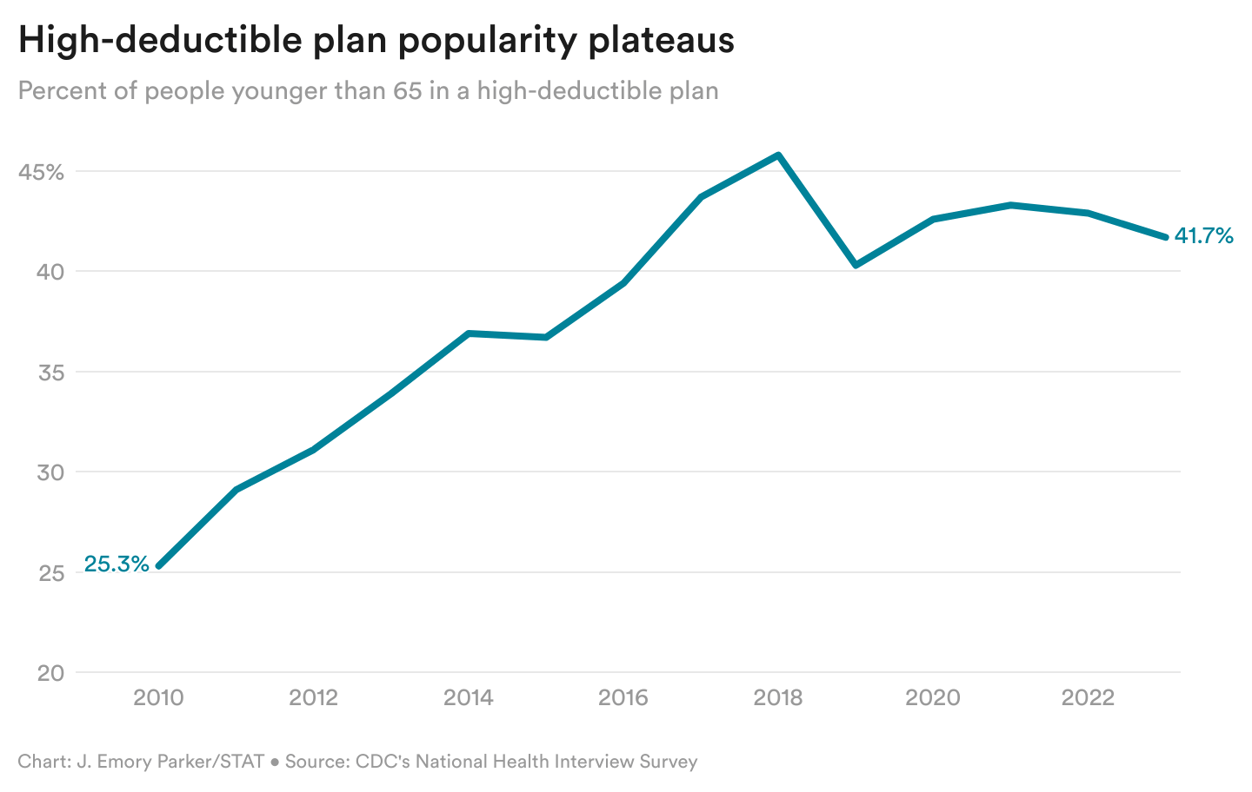
HDHPs - Emory chart

High-deductible health plans aren’t really in vogue anymore.


hospitals

Here’s my number, code me maybe

A new RAND Corp. study finds that hospitals are increasingly coding patients as being sicker than they are — with a goal of capturing more revenue, Tara writes. The number of hospital stays categorized at the highest intensity level grew 41% between 2011 and 2019, according to the study, published last week in Health Affairs. Without any upcoding, the authors estimated that growth rate would have been just 13%.

The findings drew on records from 38 million hospital stays across five states. And they highlight the frustrating notion that health insurers don’t seem to have an incentive to crack down on fraud, Vivian Ho, a health economist and Rice University professor who was not involved in the research, told Tara. 

The American Hospital Association pushed back on the findings, as it usually has with RAND’s hospital reports. The lobbying group said hospitalized patients are becoming more complicated, in part because healthier patients are increasingly migrating to outpatient settings for care. Read the study.


More around STAT
Check out more exclusive coverage with a STAT+ subscription
Read premium in-depth biotech, pharma, policy, and life science coverage and analysis with all of our STAT+ articles.

Industry odds and ends

  • This story from ProPublica’s J. David McSwane might be one of the most jaw-dropping pieces of journalism you’ll ever read. It’s about a cancer doctor in Montana who is tied to a plethora of suspicious diagnoses, galling amounts of opioid prescriptions, and premature deaths of patients. Read it. You’ll hang on to every word.
  • Centene was supposed to hold its investor day in person in New York City this Thursday, but it will now be a virtual-only event in light of the fatal shooting of Thompson, my colleague Nalis Merelli reports.
  • It’s MedPAC time again. The meetings on Thursday and Friday revolve around whether Medicare is adequately paying hospitals, doctors, nursing homes, and other major facilities.
  • I’m well aware that Anthem, the Blue Cross Blue Shield insurer that is part of Elevance Health, rescinded a policy from November that would have changed how it pays for anesthesia. Methinks there’s more to this story, though, and that it requires a bit more digging. Stay tuned.
  • The U.S. Patent & Trademark Office unexpectedly withdrew a controversial proposal that was designed to prevent pharmaceutical companies from abusing the patent system, my colleague Ed Silverman reports.
  • Brian Druker, the oncologist who helped develop the blockbuster cancer medication imatinib, resigned from his CEO perch at the Knight Cancer Institute at Oregon Health and Science University, Ken Boddie of KOIN 6 News in Oregon reports. Druker said the system has “lost sight of what is crucial” by prioritizing finances over patients and research.
  • In 2022, the federal government spent 27% more for people who were on a Medicare Advantage plan and then jumped ship to traditional Medicare compared with people who were on traditional Medicare the whole time, a new research paper from KFF shows.
  • Aya Healthcare, the largest temporary health care staffing firm in the country, is buying a major competitor, Cross Country Healthcare, for $615 million.

Thanks for reading! More next week. 


Enjoying Health Care Inc.? Tell us about your experience
Continue reading the latest health & science news with the STAT app
Download on the App Store or get it on Google Play
STAT
STAT, 1 Exchange Place, Boston, MA
©2024, All Rights Reserved.